
Fibre optic internet has rapidly become the gold standard for connectivity in both homes and businesses. With speeds up to 50 times faster than traditional ADSL connections, it has revolutionised how we work, stream, and communicate. Its adoption is growing at an incredible pace across residential and commercial settings, offering unparalleled reliability and efficiency.
While many people know that fibre optic internet is synonymous with speed, far fewer understand how it works or why it’s so much faster than older technologies. Gaining insight into this can empower individuals and businesses to make more informed choices about their connectivity needs.
What Is Fibre Optic Internet?
Fibre optic internet is a type of high-speed broadband connection that uses pulses of light to transmit data through ultra-thin strands of glass or plastic, making it significantly faster and more efficient than older internet technologies. Unlike ADSL, which relies on copper telephone wires, or LTE, which uses wireless signals, fibre optic technology is far less prone to interference and signal degradation.
To put it simply, copper wires can be compared to narrow country roads, where traffic slows down as it increases, while fibre optic cables are like a wide-open motorway made of light, allowing data to travel at incredibly high speeds with minimal obstacles. This revolutionary approach to connectivity has transformed the way we access and share information.
How Does Fibre Actually Work? The Science Behind the Speed
The Core and Cladding: The Essential Components of Fibre Optics
At the heart of fibre optic technology are two critical structural components:
The Core
The core is the innermost layer of the fibre optic cable and the pathway through which light pulses travel. This tiny, central strand is made of highly purified glass or plastic, enabling the efficient transmission of light signals over long distances.
The Cladding
Surrounding the core is the cladding, a protective layer crafted from a material with a lower refractive index. Its primary role is to keep light confined within the core by utilising a phenomenon known as total internal reflection. This process essentially “bounces” the light along the core, preventing it from escaping and ensuring minimal data loss during transmission.
The Journey of Data Through Fibre
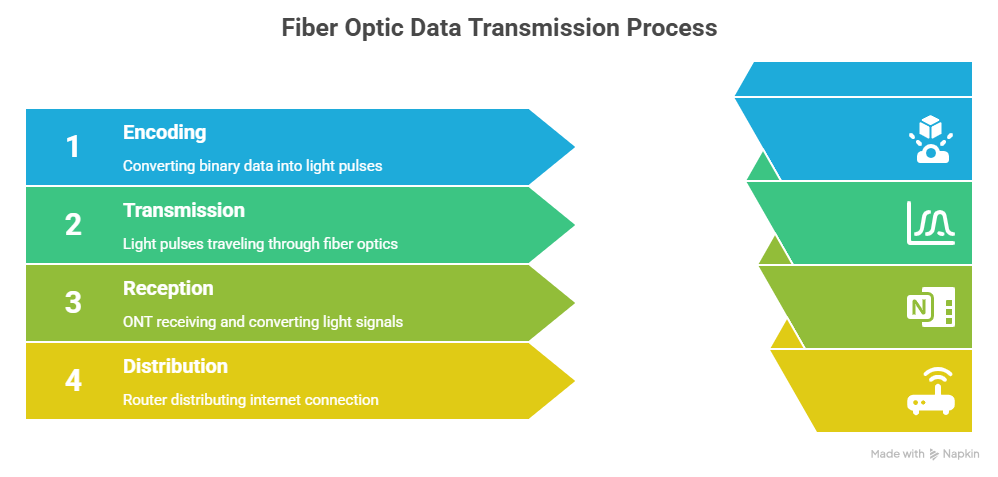
The data transmission process begins with binary information, the foundation of all digital communication. This data is encoded and converted into pulses of light using advanced laser technology. These light pulses then travel through the fibre core at velocities approaching the speed of light, navigating vast distances with remarkable efficiency and minimal signal loss.
Upon reaching the user’s premises, the light pulses are received by an Optical Network Terminal (ONT). This device plays a critical role by converting the incoming optical signals back into traditional electrical Ethernet signals. From there, the user’s router distributes the connection wirelessly to devices throughout the home or office, enabling seamless access to the internet.
It’s remarkable to note that each strand of fibre optic material, thinner than a human hair, can carry more data than hundreds of traditional copper cables combined, a testament to the efficiency and power of this cutting-edge technology.
Why Is Fibre So Much Faster?
Fibre optic internet is up to 50 times faster than traditional ADSL connections, capable of reaching speeds of 1 Gbps and beyond. This extraordinary speed is possible because light, which travels through fibre cables, moves much faster than electricity through copper wires. Additionally, fibre cables can carry significantly larger volumes of data simultaneously without congestion, making them ideal for today’s bandwidth-heavy activities. Another key advantage of fibre is its symmetric speeds, meaning upload and download rates are equally fast.
This is particularly beneficial for tasks like video conferencing, cloud uploads, and live streaming, where swift upload speeds are crucial. To put this into perspective, downloading a full 4K movie can take just 40 seconds on a 1 Gbps fibre connection, whereas the same download on an ADSL connection could stretch to over 30 minutes. Fibre’s immense bandwidth capacity also ensures that multiple high-demand activities, such as 4K streaming, online gaming, and video calls, can occur simultaneously without a drop in performance, truly revolutionising how we connect and interact online.
Rock-Solid Reliability: Built to Withstand the Elements
Fibre optic connections provide exceptional immunity to electromagnetic interference, setting them apart from traditional copper-based networks. Unlike copper, fibre is not affected by nearby power lines, electronic devices, or radio frequencies, ensuring a more stable and reliable connection even in environments with high electromagnetic activity. Furthermore, fibre demonstrates remarkable durability in adverse weather conditions. It is resistant to lightning strikes and unaffected by rain fade, both of which can commonly disrupt copper and wireless connections.
Another key advantage of fibre technology is its ability to maintain consistent performance over long distances. Unlike copper connections, which experience significant signal degradation the further they are from the exchange, fibre delivers reliable speeds and performance regardless of distance. This makes fibre an excellent choice for both urban and rural settings where distance can often be a limiting factor with traditional connections.
Finally, fibre connections offer a higher level of security. Fibre optic cables are far harder to tap into than copper wires, making them a preferable choice for businesses and organisations handling sensitive or confidential data. This added layer of protection gives users greater peace of mind in an increasingly digital world.
Low Latency: The Hidden Advantage
Latency refers to the time it takes for data to travel from one point to another within a network. Fibre optic connections excel in this aspect, offering impressively low latency of just 5–10 milliseconds (ms). For comparison, satellite connections can experience latency of 500–700ms, while ADSL connections are significantly slower still.
This low latency has a tangible impact on everyday digital experiences. For online gaming enthusiasts, it eliminates lag, ensuring faster response times essential for competitive play. During video conferencing, the synchronisation of audio and visuals remains seamless, enabling productive and frustration-free meetings. Additionally, for those streaming in 4K or even 8K resolution, fibre ensures smooth playback without buffering, even during peak usage hours. This makes fibre the ideal choice for users demanding consistent, high-performance connectivity.
Understanding the Different Types of Fibre Connections
Fibre connections come in three primary types, each offering varying levels of performance and reliability depending on how the fibre is distributed:
- FTTH (Fibre-to-the-Home): This involves a direct fibre connection from the provider straight to the premises. It is the fastest and most reliable option, making it ideal for residential users who demand high speeds and stability.
- FTTB (Fibre-to-the-Building): Here, fibre reaches a shared building, such as an apartment block, with copper wiring used to distribute the connection to individual units. This setup is common in dense urban areas. While it offers good speeds, performance may vary depending on the copper infrastructure.
- FTTC (Fibre-to-the-Cabinet): With FTTC, fibre reaches a nearby street cabinet, but the final connection to premises is completed using existing copper lines. This type of connection is more widely available but delivers lower speeds compared to FTTH or FTTB.
Future-Proofing Your Home or Business
Scalability and Emerging Technologies
One of the key advantages of fibre infrastructure is its remarkable scalability. The same fibre-optic cables delivering 1 Gbps speeds today can be upgraded to support 10 Gbps, 100 Gbps, and beyond, simply by updating the equipment at each end of the connection. This eliminates the need for expensive and disruptive re-laying of cables, making fibre an incredibly future-proof choice.
This scalability is critical to keeping pace with the demands of emerging technologies. Smart homes, IoT devices, 8K streaming, virtual reality platforms, and the growing prevalence of remote work all require steadily increasing bandwidth. Fibre networks are built to seamlessly grow with these technological advancements, ensuring users remain connected to cutting-edge capabilities.
For businesses, fibre scalability provides an added layer of flexibility and cost-efficiency. As companies grow and their connectivity needs expand, fibre infrastructure can be easily upgraded in step with these demands. This ensures businesses avoid costly infrastructure overhauls while maintaining high levels of performance and reliability.
Fibre optic internet represents the pinnacle of modern connectivity, transmitting data through fine strands of glass using light. This technology delivers speeds up to 50 times faster than traditional ADSL, sub-10ms latency for ultra-responsive connections, and complete immunity to electromagnetic interference. Furthermore, its inherent scalability ensures it’s ready to support the technologies of tomorrow as they evolve.
Whether you’re working from home, managing a business, or creating a smart home environment, fibre is not just an upgrade; it’s essential infrastructure that empowers productivity, innovation, and convenience. Don’t settle for outdated connections when fibre can unlock your full potential.
Take the next step today! Check fibre availability in your area or explore our wide range of packages tailored to meet your needs.